First, determine exactly what you want to import
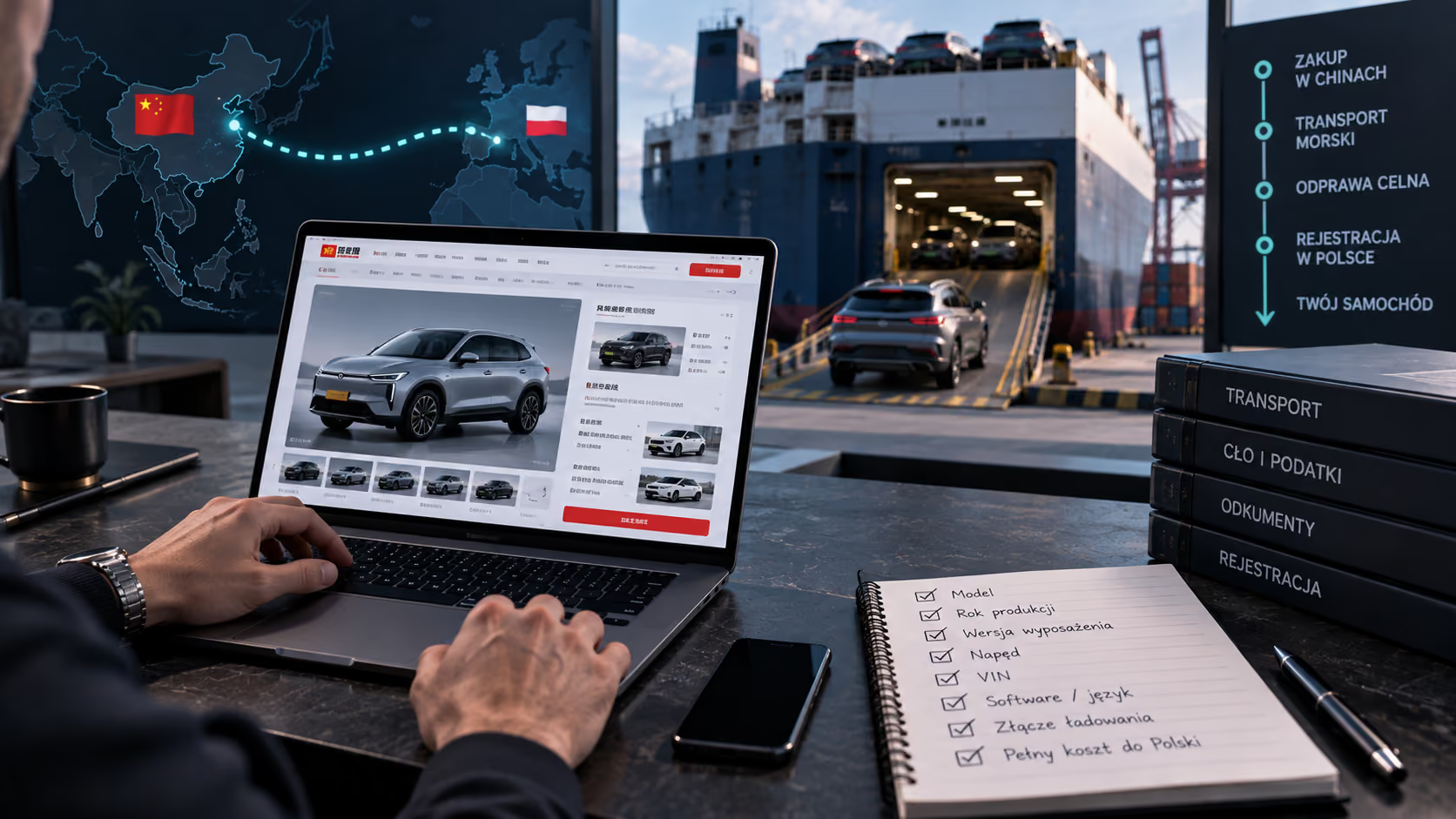
Importing doesn't start with a ship or customs clearance. It starts with a specific car. You can choose a model available in the Sorento catalog or send a link to a car found on a Chinese platform. In the latter case, it is worth providing not only the model name but also the year of manufacture, trim level, drivetrain, type of powertrain, and—if available—the VIN or other data that uniquely identifies the vehicle.
This is important because cars with the same name can have different market versions. They may differ in software, interface language, equipment, charging systems, and homologation. Sorento emphasizes that software, language, and charging issues must be verified for the specific model, not for the entire brand.
1. Valuation: don't just look at the price in the listing
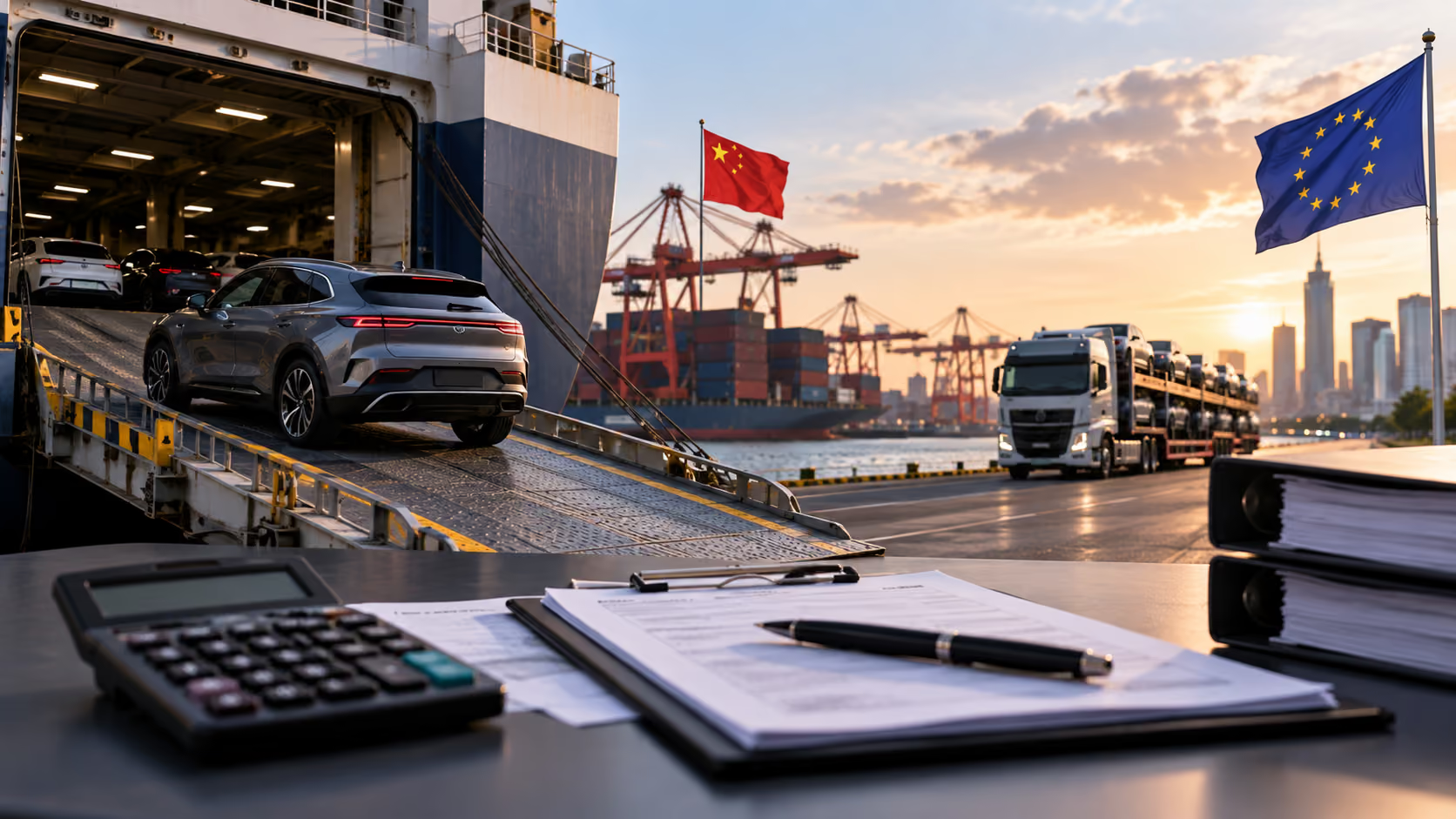
The price shown on a Chinese website is not the final cost of a car ready for pickup in Poland. Importing involves additional costs related to transport, customs clearance, taxes, and preparing the vehicle for registration. The European Commission treats the import of a car from a third country as the import of goods; as a rule, customs duty and import VAT apply, unless a specific exemption or preference applies. The basis for import VAT includes the customs value as well as specific duties and costs associated with the import.
That is why Sorento prepares an individual valuation for each specific car. It is not advisable to promise one universal price for all cars on the website, as the cost structure depends on the vehicle and current logistics conditions.
2. Deposit and reservation
After accepting the terms, the client pays a deposit. Sorento reserves the chosen car and proceeds to the verification and purchase organization stage. At this stage, it is crucial that the client has a clear understanding of what the order entails: which version of the car is the subject of the transaction, what the agreed scope of additional work is, and what elements are included in the valuation.
3. Pre-purchase car inspection
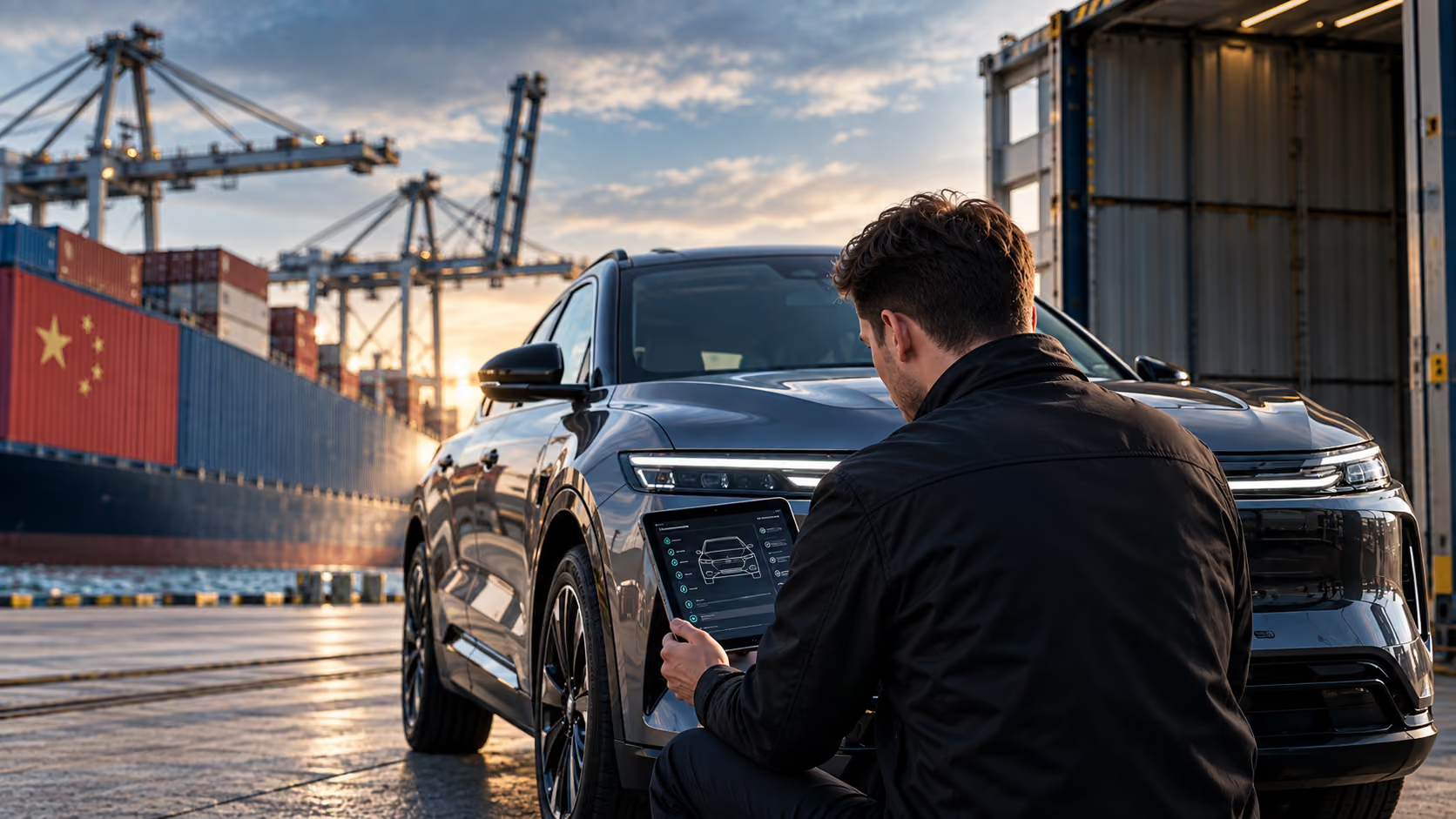
Inspection is one of the key stages in reducing the risk of buying a car remotely. Sorento organizes an expert inspection in China. According to the company's materials, they verify, among other things, the condition of the bodywork, signs of tampering with bolts, the battery, tires, and the car's compliance with the offer.
For an electric car, the condition of the traction battery and the consistency of the declared version with the actual configuration of the car are of particular importance. For any vehicle, it is also worth checking the markings, equipment, condition of the windows and body parts, and whether any disclosed damage was described beforehand.
An inspection does not mean that the car automatically becomes "accident-free." If a car has a history of damage, it should be disclosed and taken into account in the purchasing decision. The purpose of the inspection is to provide information about a specific vehicle, not to issue a universal guarantee of its condition.
4. Purchase decision and settlement
After receiving the inspection results, the client decides whether to proceed with the purchase. Sorento's materials describe a model in which, after positive verification, the purchase is settled, and the remaining part of the payment is settled after the vehicle arrives in Poland. The exact terms and payment rules should be specified in the individual contract.
5. Export documents and preparing the car for transport
After the purchase, documents are needed to allow the car to be exported from China and transported further. Sorento declares that it will organize the export documents, prepare the car for transport, and load it into a container. For the client, this primarily means offloading the formal and logistical aspects that would otherwise be their responsibility if importing independently.
6. Sea transport to Europe
The car is transported by sea. Sorento informs that the vehicle is insured for the duration of the sea voyage. However, the transport time is not a single fixed date: it depends on space availability, the port, the carrier's schedule, and the logistics situation.
That is why it is worth distinguishing on the Sorento website estimated total process time from the date that can be provided for a specific order. According to company materials, the general estimated import time is approximately 40–65 days, although individual models in the catalog may have different values.
7. Customs clearance and taxes
Once the car arrives in the European Union, import formalities must be completed. For a car imported from China, this includes, among other things, customs clearance and the settlement of import duties. From a tax perspective, importing from a non-EU country is a separate event from the subsequent registration of the car in Poland. citeturn117905search1turn117905search6
It is also important to note that electric cars may be subject to additional European Union trade measures. For new battery electric vehicles originating from China, additional definitive countervailing duties currently apply, the rate of which depends on the manufacturer or group of manufacturers. The Commission indicates, among others, rates of 17.0% for BYD, 18.8% for Geely, 35.3% for SAIC, 20.7% for other cooperating manufacturers, and 35.3% for other producers subject to the measure. These measures remain in effect for five years from their entry into force. citeturn346123search24turn346123search2turn346123search3
Therefore, one should not simply apply a generic "Chinese EV duty" to every quote. It is necessary to verify the vehicle's classification and the specific exporter.
8. Excise tax in Poland
Passenger cars subject to Polish excise tax are settled according to rates depending on the type of drive and, in certain cases, engine capacity. As of January 1, 2026, the base rate is 3.1% for "other" passenger cars, 18.6% for cars with engines over 2000 cm³, 1.55% for specific hybrids up to 2000 cm³, and 9.3% for specific hybrids over 2000 cm³ up to 3500 cm³. Regulations provide separate rules for individual categories, so the specific amount must be determined for each given car. citeturn117905search0
In the case of an electric car, it is necessary to check whether the specific design and classification qualify for an applicable exemption or other tax treatment. One should not apply rules concerning internal combustion engines to every electric vehicle.
9. Technical inspection and vehicle compliance
Importing a car does not end at customs clearance. For a vehicle to be registered, the appropriate documents must be collected and requirements for roadworthiness must be met. The Polish registration procedure requires, among other things, proof of ownership, vehicle compliance documents—where required—and a technical inspection certificate, if applicable. For a vehicle imported from outside the EU, proof of import customs clearance is also required for the first registration. citeturn875406search0turn875406search1
In practice, this is highly significant for Chinese market versions. The mere fact that a model is sold in China does not automatically mean that a specific unit has European type approval. The EU type approval system serves to confirm that a given vehicle type meets safety, environmental, and production requirements. For vehicles that do not have a proper homologation path, an appropriate approval procedure may be required. citeturn875406search0turn875406search8
10. Translations, documentation, and registration
In the final stage, the documentation required for registration is prepared. Sorento identifies excise tax, inspection, translations, and registration as elements of post-arrival vehicle handling. Polish registration documentation also requires the submission of proof of customs clearance for the first registration of a car imported from outside the EU. citeturn117905search3turn875406search6
The owner of a vehicle imported from outside the EU is required to submit a registration application within 30 days from the date the vehicle is released for free circulation by the National Revenue Administration (KAS). citeturn875406search1
11. What about language, CarPlay, and online services?
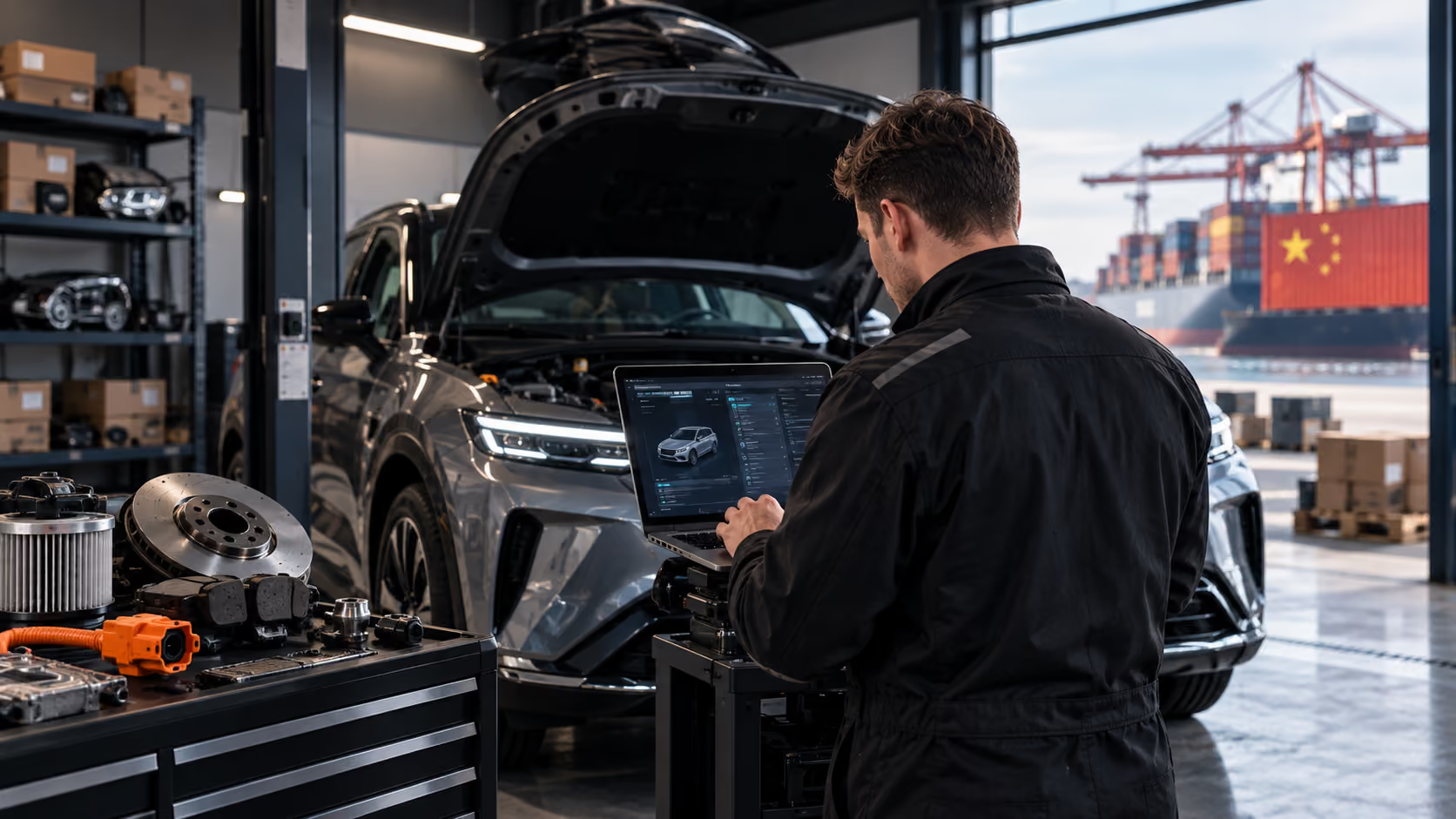
This is a separate stage of vehicle preparation that should not be confused with registration itself. Sorento notes that some cars have global software with Polish language support, but this is a small percentage. Some cars have English, and Chinese versions may only have Chinese. The possibility of localization depends on the make and model.
The same applies to CarPlay, Android Auto, manufacturer apps, online services, or the so-called master account. The possibilities depend on the system used in a specific car. Therefore, such elements should be confirmed before purchase and, if needed, included in the quote as separate work items.
12. What about charging electric cars?
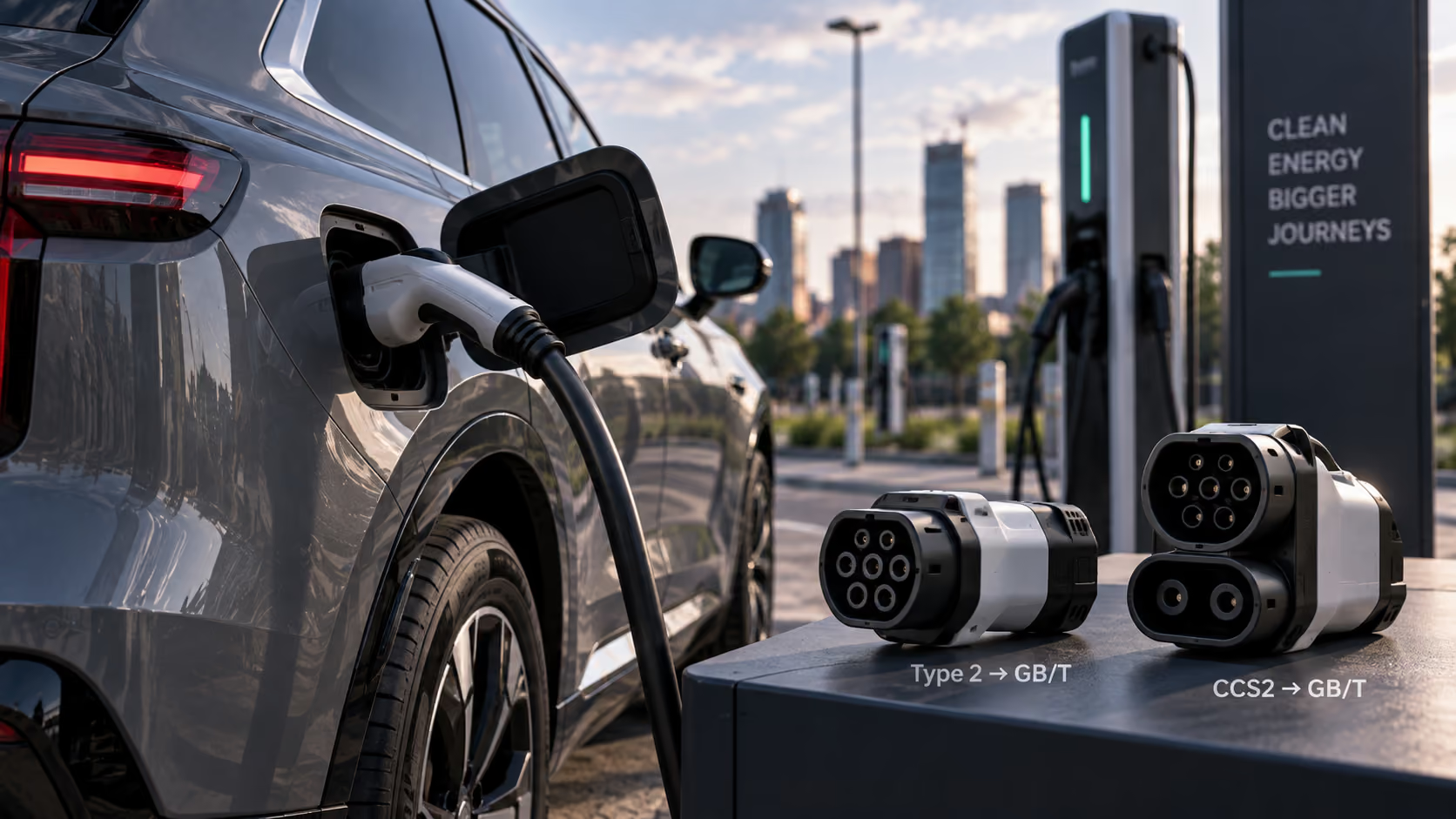
Chinese EVs may use the native GB/T standard. Sorento points to a solution based on a Type 2 → GB/T adapter and the possibility of using a CCS2 → GB/T adapter for fast charging. However, this does not mean that every model will have the same charging power. The maximum power of an adapter is only a parameter of the adapter itself; the actual charging power depends on the car, battery, temperature, state of charge, and the capabilities of the charging station.
13. How long does the import take?
Sorento materials provide an estimate of approximately 40–65 days. The timeline for a specific vehicle may vary. It is influenced by factors such as vehicle availability, time required to arrange the purchase, inspection, export preparation, waiting for transport, sea freight, customs clearance, and final processing in Poland.
It is safest to treat 40–65 days as an estimated process time, and the timeline for a specific order as information dependent on the current schedule.
14. Vehicle collection in Poland
Once the formalities are completed, the car is ready for collection. Sorento offers the option of collection at their headquarters or arranging transport within Poland. The cost of domestic transport is determined on an individual basis.
Summary: How does importing with a professional intermediary differ from buying on your own?
Buying a car directly in China might seem like a simple transaction, but the purchase price is just the beginning, with additional tax, customs, logistics, technical, and registration costs to consider. With the Sorento model, the importer handles a large part of the organization: from valuation and inspection, through transport and documentation, to the procedures performed after the car arrives in Poland.
The most important rule is simple: before buying, you must evaluate the specific vehicle, its market version, condition, software, charging port, registration eligibility, and the full scope of costs. These are the elements that determine whether a given car is a good candidate for import.
In this article
Most popular